The short answer
Before your first international trip, check five things: documents (a passport valid at least six months beyond your dates, plus any visa), money (a card that works abroad and a little local cash), your phone (an eSIM or roaming plan and offline maps), health (any required vaccinations, medication in your carry-on, and travel insurance), and logistics (a booked airport transfer and offline copies of every confirmation). Handle these and the trip itself is the easy part.
Amir’s first trip abroad nearly ended at the check-in desk. His passport was valid — for another four months. What nobody had told him is that many countries require at least six months of validity beyond your travel dates, and the airline, not wanting to fly a passenger who might be turned away, was well within its rights to refuse him. He made the trip, barely, after a frantic call and a lucky exception. He also learned the real lesson of first international travel: it is never the big things that trip you up. It is the small, unglamorous ones nobody thought to mention.
Seasoned travelers run these checks on autopilot. First-timers learn them at the airport. Here is the list, so your first trip abroad is the good kind of memorable.
1. Documents: the six-month rule and more
Your passport should be valid for at least six months beyond your return date — check this first, because renewals take time. Confirm whether your destination needs a visa or an entry authorization for your nationality, and sort it early; some are instant online, others take weeks. Photograph your passport and store the copy on your phone as a backup.
2. Money: don’t rely on one card
Tell your bank you are traveling so they do not freeze your card on the first foreign purchase. Check your card’s foreign-transaction fees, bring a second card as a backup in a separate place, and carry a little local cash for the taxi, the tip, or the shop that does not take cards. Airport currency counters offer the worst rates — get cash from an ATM in the destination instead.
3. Your phone: connectivity and offline maps
Sort connectivity before you land: an eSIM you activate on arrival, or a roaming plan, so you are not hunting for wifi at the airport. Crucially, download offline maps of your destination — the moment you can navigate without signal is the moment a foreign city stops being intimidating. Save your accommodation’s address offline too.
4. Health: the stuff you hope not to need
- Check whether your destination requires or recommends any vaccinations, and leave time for them.
- Pack medication in your carry-on, in its original packaging, with enough for the whole trip.
- Get travel insurance. A single overseas medical bill can cost more than the trip; insurance is the cheapest peace of mind you will ever buy.
- Note the local emergency number and the nearest embassy.
5. Logistics: the first hour and the paper trail
The most stressful moment of any trip is the first hour in a new country, tired and disoriented. Remove the guesswork: know exactly how you are getting from the airport to where you are staying, and book it if you can. Then keep offline copies of every confirmation — flights, hotel, transfers, tickets — because that is precisely when your signal will vanish and your inbox will refuse to load.
Seasoned travelers are not braver than you. They have just moved the small stuff out of their memory and into a system.
Keep it all in one place
Notice the thread running through every item: the difference between smooth and stressful is having your documents, plans, and confirmations organized, offline, and in one place — not scattered across your inbox, your camera roll, and your memory.
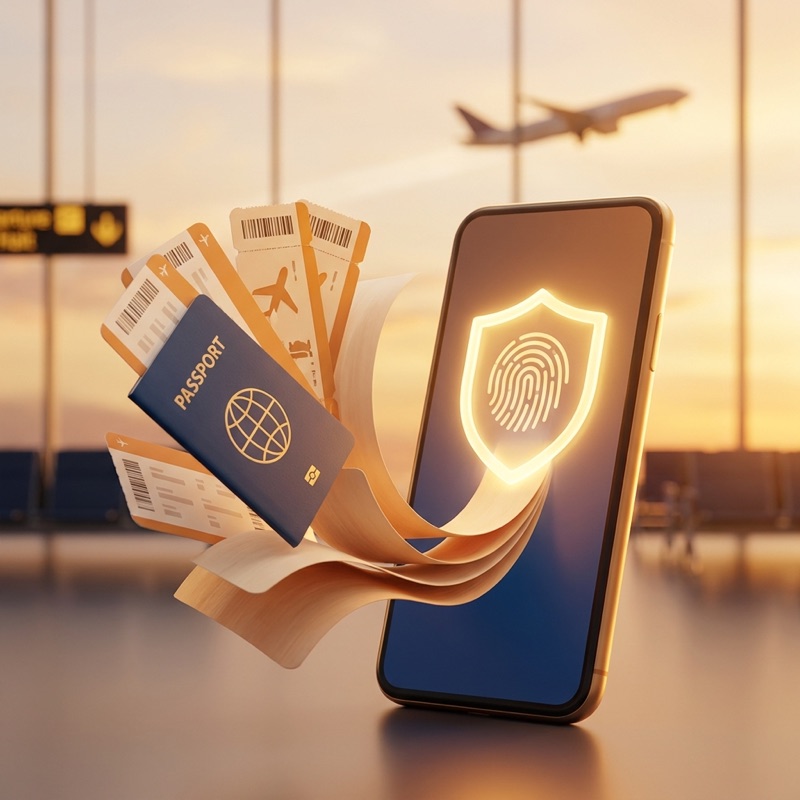
That is what TripOverall is for. It holds your itinerary, budget, packing list, and — importantly for a first trip — your passport, tickets, and confirmations, stored on your device behind your fingerprint and available offline when you need them most. Its AI can even build your first day-by-day plan so the blank page never intimidates you. It is free on iPhone and Android, and it turns the daunting logistics of a first international trip into something you can hold in one hand.